Luma Island is coming to Xbox Series X|S on December 2, 2026, with full cross-platform multiplayer and support for up to four players, according to a November 11 Xbox Wire post from developer Feel Free Games. The studio says its cozy adventure is designed for people with different play styles: players can farm and decorate, explore caves and temples, pursue professions, or raise magical Lumas together.
The most concrete design choice is player control over pressure. Luma Island has Cozy, Adventure, and Hero modes, and the developer says it removes stamina bars, inventory limits, and a forced bedtime clock. That can make the game easier to approach for a family group or a mix of experienced and newer players, though it does not by itself establish formal accessibility certification or guarantee that every player will find the game accessible.

What was announced for Xbox?
Feel Free Games describes Luma Island as its debut game, first launched on PC in 2024. The developer says more than 800,000 PC players have visited the island so far. The Xbox Series X|S version is scheduled for December 2, 2026, and the studio says the release will include full cross-platform multiplayer with up to four players across available platforms.
The announcement is a developer introduction rather than an independent technical review. It does not provide a complete performance analysis, accessibility certification, or every detail about cross-play invitations and save transfer. Players should check the current Xbox store page and the game’s official support information for those details closer to launch.
Three modes let a group choose its pace
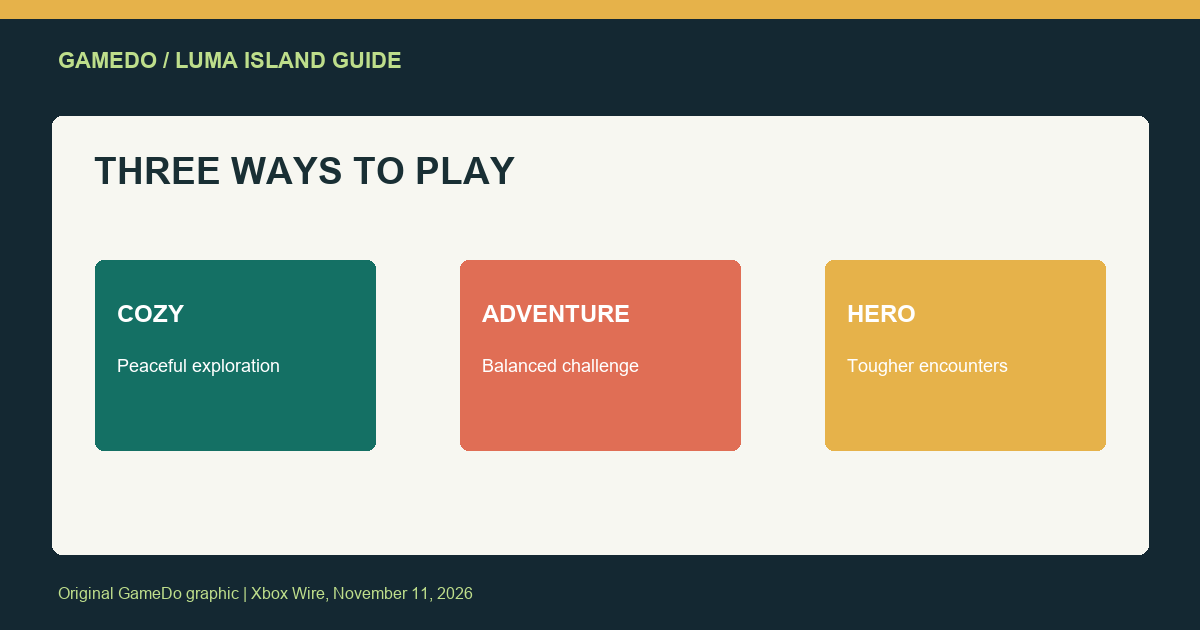
Cozy Mode is described as peaceful exploration where combat only happens if the player chooses it. That can suit someone who wants to focus on building, farming, crafting, or discovery without being pushed into frequent fights.
Adventure Mode is presented as a balanced mix of discovery, light danger, and puzzle-solving. It appears to be the middle ground for players who want some challenge while keeping the island’s relaxed activities central.
Hero Mode brings faster, tougher enemies and more demanding encounters for players who want a higher difficulty. This option lets experienced players seek more pressure without requiring the entire group to treat the game as a combat-first adventure.
The practical benefit for a U.S. household or friend group is that people may be able to share the same world while choosing a level of tension that feels comfortable. The exact way difficulty works in multiplayer should be checked in the game, since the announcement does not explain whether a group uses one shared setting or whether individual preferences can differ.
Less routine friction, more room to choose an activity
The developer says Luma Island has no stamina bars, no inventory limits, and no clock forcing players to go to bed. Those decisions remove several common interruptions in farming and survival games. A player can spend a session tending crops or decorating a home without repeatedly stopping because a stamina meter is empty or storage is full.
That does not mean the game has no goals or challenge. The island includes caves, temples, environmental puzzles, traps, professions, and exploration. It means the team says players are not constrained by those particular timers and meters while deciding what to do next.
For a group with different interests, this can make parallel play more natural. One player might work on the homestead while another pursues a profession or explores a temple. Whether the systems remain engaging over long sessions is something players and independent reviews will need to assess after release.
Professions give players different roles
Feel Free Games lists professions including Archaeologist, Blacksmith, Brewer, Cook, Fisherman, Jeweler, Shipwright, and Treasure Hunter. The developer says each brings its own recipes, tools, and goals. In a multiplayer group, professions can help players feel that they contribute in different ways instead of all repeating the same activity.
Before starting with friends, it may help to agree on what each person enjoys. A player who likes crafting can focus on a production profession, while someone who prefers exploration can look for discoveries and materials. The announcement does not say that roles are locked or that one profession is required to complete the game, so treat specialization as an invitation to experiment rather than a mandatory party setup.
Exploration, creatures, and a shared homestead
The developer describes several areas and activities: farming, forests, mountains, jungles, temples, and Pirate Cove. It says players can explore professions and collect mysterious eggs that hatch into Lumas. These companions can accompany players, fight nearby enemies, or alert them to hidden artifacts, according to the announcement.
The homestead is the calm anchor between expeditions. Players can grow crops, raise animals, build decorative items, and develop the farm. That structure gives a group a place to return to after exploring, and it creates goals for players who prefer creative projects over combat.
How to plan a first session with friends
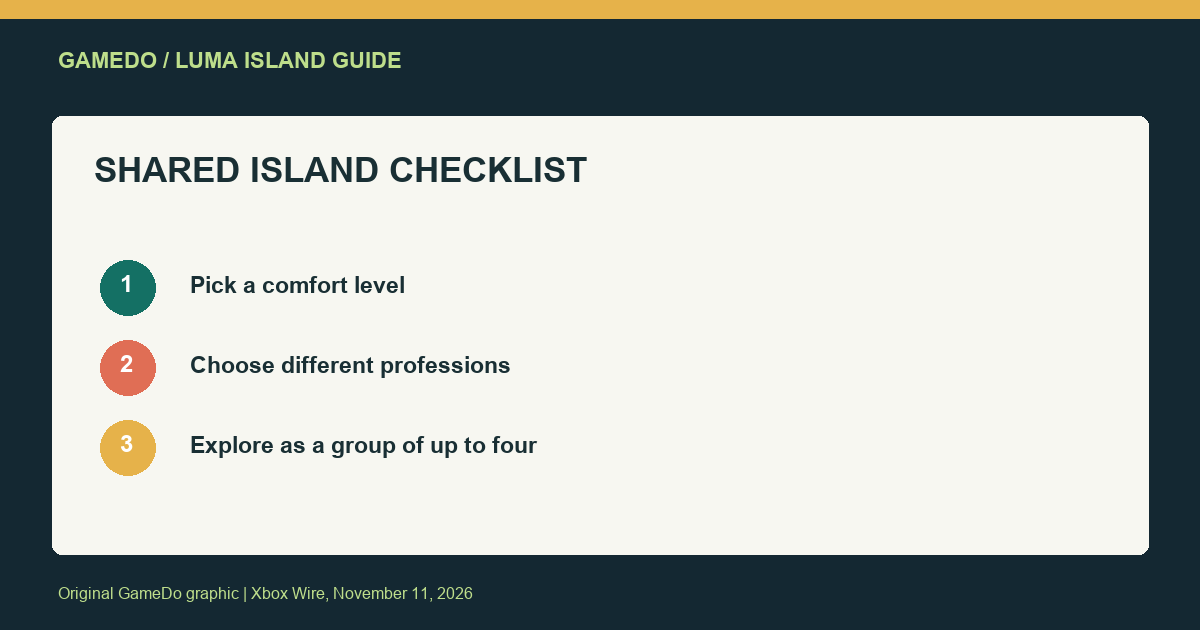
- Pick a shared starting goal. Decide whether the group wants to build the homestead, explore, or learn a profession first.
- Talk about challenge preferences. Choose a mode that suits the group, and confirm how multiplayer difficulty settings work in the final game.
- Divide interests, not responsibilities. Let players try different professions without making one person responsible for every resource.
- Use the first session to learn the map. Explore at a comfortable pace and note where the group wants to return.
- Verify cross-platform details. Before launch, check which platforms can play together and how invitations work.
For a parent introducing a younger or less experienced player, Cozy Mode may provide a lower-pressure starting point, based on the developer’s description. For a mixed group, it is worth asking what each person wants from the session rather than assuming everyone wants to optimize progression. Luma Island’s stated design gives groups several different activities to try together or in parallel.
What the announcement does not prove
“Built for everyone” is the developer’s framing, not a substitute for specific accessibility features or independent testing. The post does not list options such as text scaling, color filters, remapping, screen-reader support, or detailed difficulty customization. Players who rely on particular accommodations should check the Xbox store accessibility section and ask the developer about the features they need.
Likewise, full cross-platform multiplayer does not automatically confirm cross-save, shared purchases, or identical performance across PC and console. The studio says players can play together across available platforms, but players should look for precise support details before purchasing multiple copies or planning a long-running shared save.
Who should keep Luma Island on the list?
- Co-op groups who want up to four players and activities beyond combat.
- Families and mixed-experience groups who value a choice of challenge modes and a relaxed building loop.
- Players who enjoy life simulation and exploration more than timed survival pressure.
- Players who want a technical accessibility guarantee should wait for a detailed feature list and independent testing rather than relying on broad marketing language.
Bottom line
Luma Island is scheduled for Xbox Series X|S on December 2, with up to four-player cross-platform multiplayer, three modes, professions, exploration, farming, and a shared homestead. Its design pitch is flexibility: Cozy, Adventure, and Hero modes; no stamina bars, inventory limits, or forced bedtime clock; and several ways for a group to spend time together.
For players in the U.S. looking for a lower-pressure co-op game, those are promising design choices, but they are not a guarantee that every feature will suit every player. Check the final platform details, cross-play support, and accessibility options before launch. The most useful test will be whether a group with genuinely different play styles can each find a satisfying activity on the island.
Facts checked against the developer’s Xbox Wire post dated November 11, 2026. Features and platform details may change before release.
Source
- Xbox Wire: How Luma Island Was Built for Everyone on Xbox Series X|S (November 11, 2026).
Questions to check before buying
Before purchasing, confirm the December 2 release date on the Xbox store page in your region and check whether the listing has been updated with final multiplayer requirements. Cross-platform play can depend on platform accounts, privacy settings, and invitation procedures. The developer’s announcement confirms the overall intent, but it does not explain every setup step. Each player should make sure their account can participate in online multiplayer and that the relevant privacy settings allow friends to join.
Also consider how your group wants to handle sessions when one person is absent. A relaxed life-simulation game can become a long-running shared project, but players may have different schedules. Agreeing on whether people can progress independently or whether the group wants to save major discoveries for shared sessions can prevent frustration. Check the game’s current save and multiplayer rules before assuming that all progress behaves the same in solo and co-op play.
Accessibility is more than a relaxed difficulty
Removing stamina limits and optional combat can reduce pressure, but accessibility includes many other needs. Players may need adjustable text, remappable controls, visual alternatives, subtitles, or options for reduced motion. The November 11 post does not enumerate those features. If a specific accommodation is important, ask the developer directly and look for a detailed accessibility breakdown before deciding the game is suitable.
Difficulty modes also do not necessarily change every barrier. Cozy Mode may remove or reduce combat according to the developer, but it may not alter puzzle timing, reading requirements, camera behavior, or control complexity. The practical approach is to treat the modes as one useful part of the design rather than as proof of universal accessibility.
Why the no-clock design could help co-op
In games with a daily clock or a stamina meter, one player’s pace can determine how much the entire group accomplishes. Removing those pressures can make it easier to stop and explain a system, take a break, decorate, or explore without feeling that a timer is wasting the group’s opportunity. This can be especially helpful when some players are learning the controls or want to read quest text carefully.
The tradeoff is that a game still needs goals to keep long-term play engaging. Luma Island’s professions, recipes, tools, temples, creatures, and homestead offer potential directions, but the announcement does not establish how quickly those goals unfold or how much content is available at launch. Reviews after release can help answer whether the freedom feels rewarding over many sessions.
When the game launches, compare the experience across modes using the same activity rather than judging from different parts of the island. A group can try a short exploration route in Cozy Mode, then decide whether Adventure offers the amount of danger they want. Keep expectations grounded: early impressions are useful, but launch updates and player feedback may change how the systems are balanced.