CD Projekt is using AI-assisted voice modification for Jacek Rozenek’s Polish-language performance as Geralt in The Witcher 3: Songs of the Past, a 2027 expansion. Rozenek, who voiced Geralt in previous Polish Witcher releases, recorded new lines; the audio company Respeecher is adjusting the performance to sound closer to his earlier recordings. Game File published the original interview on November 11, and PC Gamer reported the story on November 12, 2026.
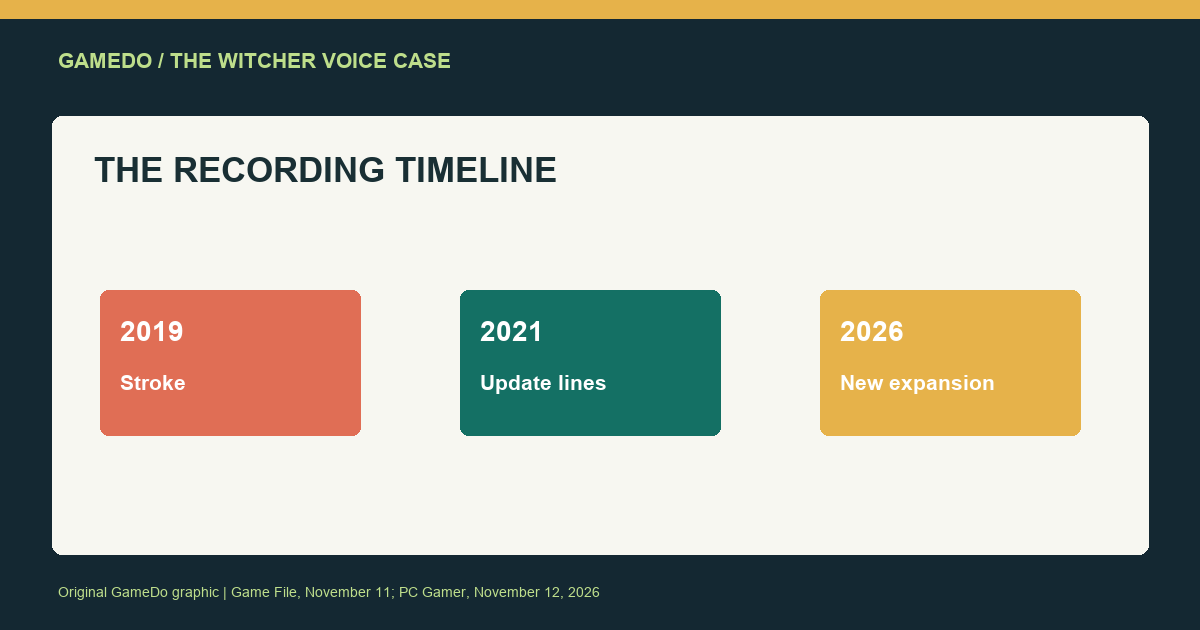
This case is unusually specific. Rozenek suffered a stroke in 2019, later returned to acting, and agreed to the voice treatment, according to the reporting. CD Projekt wanted to work with him again but worried that a noticeably lower, rougher voice would sound inconsistent when the expansion’s new dialogue appears alongside thousands of older lines recorded for the same point in Geralt’s story.
What happened
Game File’s November 11 interview with CD Projekt localization producer Mikołaj Szwed and Rozenek describes the studio’s decision to bring the actor back for Songs of the Past. Rozenek had played Geralt in the Polish versions of earlier Witcher games. After his stroke, his voice changed. He continued training and returned to acting, but the new sound differed from the recordings players already knew.
The expansion is set within the timeline of The Witcher 3, rather than years later. That creates a continuity challenge: new dialogue and reactions could appear next to lines recorded more than a decade earlier. CD Projekt chose to have Rozenek perform the new material and work with Respeecher to adjust it toward the earlier sound. PC Gamer reported that Rozenek gave permission and supported the approach.
That is not the same as generating a performance without the actor. In the reported process, Rozenek supplied the new acting; AI-assisted processing altered characteristics of the recording. The distinction matters because voice performance includes interpretation, timing, emotion, and delivery, not only timbre.
Why the studio chose this approach
According to Game File, CD Projekt wanted Rozenek to remain Geralt’s Polish voice in the new expansion. The team considered whether the difference between his current voice and the original recordings would be jarring. The expansion would add not only story dialogue but reactions, battle cries, and short lines that could play in existing areas of the game. Matching the older sound was therefore a continuity choice tied to a specific timeline and an actor who was available to perform.
Respeecher’s work was not described as an automatic one-click process. The PC Gamer account says the team spent dozens of hours training models and refining details, while still dealing with artifacts that did not fully disappear. The challenge included retaining emotional range—such as shouts, fear, anger, and quieter inflections—rather than simply making the voice lower or younger.
Those details are relevant to players because a voice can sound technically similar while losing the performance qualities that make a character recognizable. The studio’s stated aim was to preserve Rozenek’s identity and delivery while reducing the audible gap between old and new recordings. Whether the result works artistically will be judged when players hear the finished expansion, not by the technology label alone.
The consent question is central
AI voice work is controversial because a voice is part of a performer’s professional identity and can be reused, edited, or synthesized beyond the context they expected. In this case, the reporting says Rozenek participated in the new recording and consented to the modification. That makes the case materially different from using a voice model without the performer’s knowledge or approval.
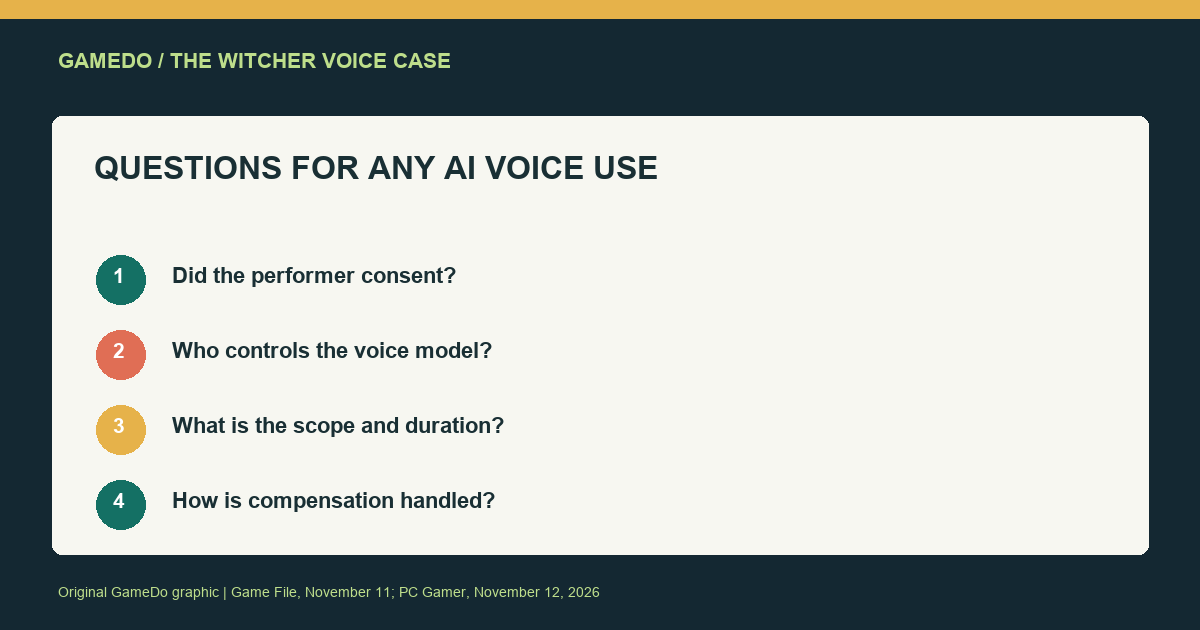
Consent should still be specific and informed. Useful questions include which lines or recordings can be processed, what model or vendor receives the material, how long the model is retained, whether it can be reused for other projects, who can approve the final output, and how compensation reflects both performance and digital processing. The public reporting explains the broad creative rationale, but does not publish every contract term.
Why this does not settle the wider AI debate
A consent-based, actor-led exception does not answer whether generative AI should be used for routine dialogue, background characters, localization, or replacing performers. Those situations can involve different power dynamics and risks. A performer who agrees to one bounded adjustment for a role they already played is not automatically agreeing to broad future reuse of their voice.
CD Projekt has described this as a special case, according to the reporting. The studio said it is not planning a similar treatment for Doug Cockle, Geralt’s English-language actor, and indicated that the Polish voice would not need adjustment in hypothetical future games set later in the timeline. That distinction supports the studio’s stated continuity rationale, but the details of any future production would need to be assessed separately.
Voice actors have raised concerns across the industry about control over digital replicas, consent, job displacement, and compensation. This example can show that technology may help an actor return to a familiar role under agreed conditions; it should not be used to claim that all AI voice practices are harmless or that one project establishes a universal standard.
What players should listen for
When Songs of the Past releases, players can evaluate the result in context. Does Geralt sound consistent when new and old lines appear close together? Are emotion and character preserved, or does the processing make the performance feel flat? Are credits clear about Rozenek’s performance and Respeecher’s contribution? These questions focus on the finished work and the people involved rather than treating “AI” as a single quality verdict.
Players should also distinguish confirmed statements from speculation. The reported process concerns the Polish-language Geralt performance in this expansion. It does not establish that every Witcher language track, every character, or future CD Projekt project will use the same technique.
Questions the public record does not answer
- Contract scope: the exact recording rights, model-retention period, and limits on reuse have not been made public in the cited reporting.
- Compensation: the articles do not disclose the commercial terms for Rozenek or Respeecher.
- Final quality: the expansion is forthcoming, so players have not yet heard the complete finished result.
- Broader policy: one production decision does not define CD Projekt’s approach to every future voice performance.
Keeping those unknowns visible is important. A report can accurately say that the actor consented and that the studio had a continuity problem, while still acknowledging that outsiders cannot verify private contract terms or judge the final mix before release.
Bottom line
For The Witcher 3: Songs of the Past, CD Projekt is pairing the original Polish Geralt actor with AI-assisted audio modification after his voice changed following a stroke. Rozenek recorded the new performance and, according to the November 11 Game File interview and November 12 PC Gamer report, agreed to the treatment. The studio’s stated reason is continuity within the same game timeline.
The case is best understood as a specific collaboration, not a blanket endorsement of synthetic voice acting. Consent, scope, control, compensation, and credit remain important questions for any AI-assisted performance. Players can assess the artistic result when the expansion arrives, while remembering that the public reporting does not disclose every contractual detail.
Reporting checked November 12, 2026. The article distinguishes published reporting from undisclosed contract terms and from broader industry debate.
Sources
- Game File: “This was a special case.” The Witcher 3’s 2027 expansion and Geralt’s original Polish voice actor (November 11, 2026).
- PC Gamer: CD Projekt used AI to modify the voice of Geralt’s Polish actor (November 12, 2026).
How the decision fits into the game’s timeline
The continuity issue is easier to understand when considered alongside how expansions are built. Songs of the Past adds new dialogue to an existing game rather than replacing the original performance. Players may hear newly recorded lines in the same regions, quests, or combat situations where older recordings remain. If the character’s voice shifts noticeably between those moments, the difference can distract from the story even when each individual line is performed well.
CD Projekt’s reported solution was to keep Rozenek involved while using post-production to narrow that gap. This keeps the actor’s interpretation at the center of the new material and treats the processing as a way to fit that performance into an established soundscape. It is a creative decision, not a technical necessity that every studio must follow.
There are other possible approaches, each with tradeoffs: accept the changed voice as part of the character’s aging, rewrite or reduce the new dialogue, record a different performance, or use digital processing. The reporting says CD Projekt wanted Rozenek to return and believed the timeline made a close match important. Players may disagree about which choice they prefer, but the rationale is more specific than a generic claim that AI is faster or cheaper.
Performance versus sound matching
A voice actor’s contribution is more than the sound’s frequency range. The actor makes choices about pace, emphasis, breath, emotion, and how a line responds to the scene. Audio processing can alter a recording’s tone, but it does not independently supply the full dramatic interpretation. In this case, the reporting says Rozenek performed the new lines and the technology was used to adjust the resulting voice toward earlier recordings.
That distinction is important in discussions about replacement. If a studio uses a model to produce lines that the performer never recorded, the consent, compensation, and creative-control questions are different from processing an actor’s new performance. The public description of this project belongs to the latter category, though the exact boundaries are not fully documented in public.
What informed consent should cover
Consent is strongest when it is specific to the project, the recordings, the intended transformations, and the duration of use. A performer should know whether raw recordings or a trained model will be stored, whether a vendor can access the material, whether the model can be used for future content, and how approval works if the final voice differs from expectations.
Compensation also deserves separate attention. A performer’s time in the recording booth, the right to use their voice, and the ongoing value of a digital model are not necessarily the same thing. Public reporting in this case does not disclose payment or licensing terms, so readers should not infer that consent automatically answers every labor question.
Credit matters too. Clear credits help audiences understand who performed, who modified the audio, and what role the vendor played. They also preserve the performer’s contribution in the public record. The expansion’s final credits and any accompanying production notes will provide more information than current reports do.
Potential benefits and risks
Used with an actor’s agreement, voice modification may make it possible for a performer to continue a role despite changes in their voice, health, or recording conditions. It can also help keep a character’s sound coherent across new material and an older game. Those benefits are meaningful in a franchise where players may have spent dozens of hours with a familiar voice.
The risks are not removed by one positive example. Digital voice tools can make it easier to generate large volumes of dialogue, reduce opportunities for actors, or reuse a voice beyond its original context. If permissions are broad or unclear, performers may lose control over how their identity is represented. The technology can also introduce artifacts or emotional flattening that affect the audience’s experience.
The practical safeguard is not to label all uses acceptable or unacceptable in advance. Instead, examine who made the performance, what was transformed, whether the actor had meaningful control, how the work is credited, and whether the model is limited to the agreed purpose. Those questions make the discussion concrete.