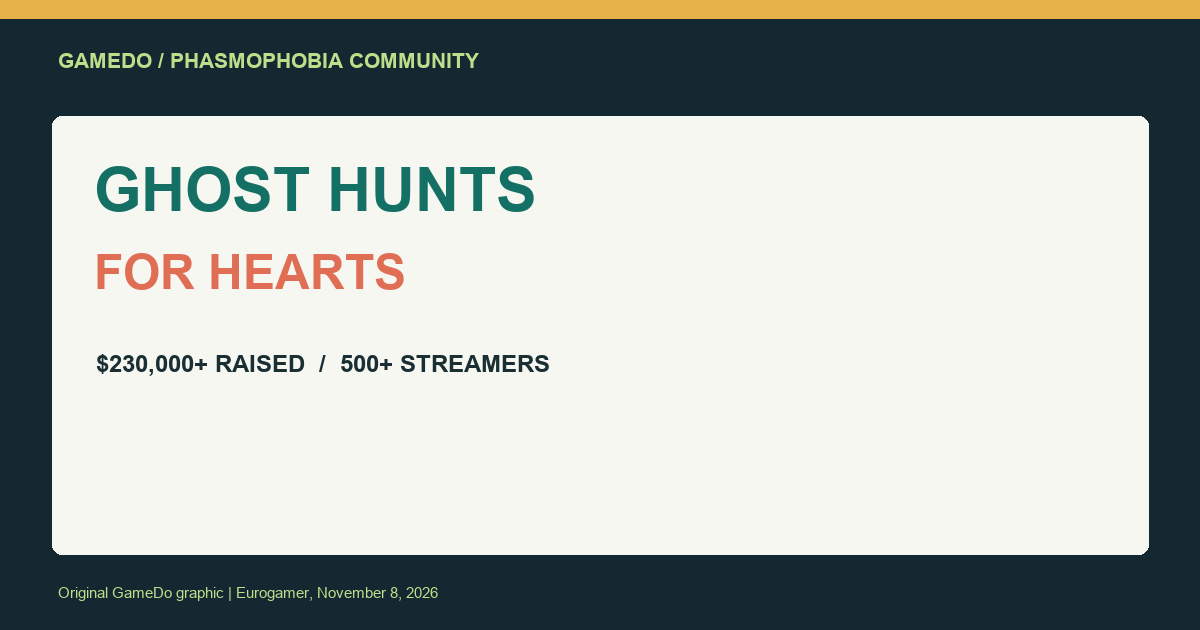
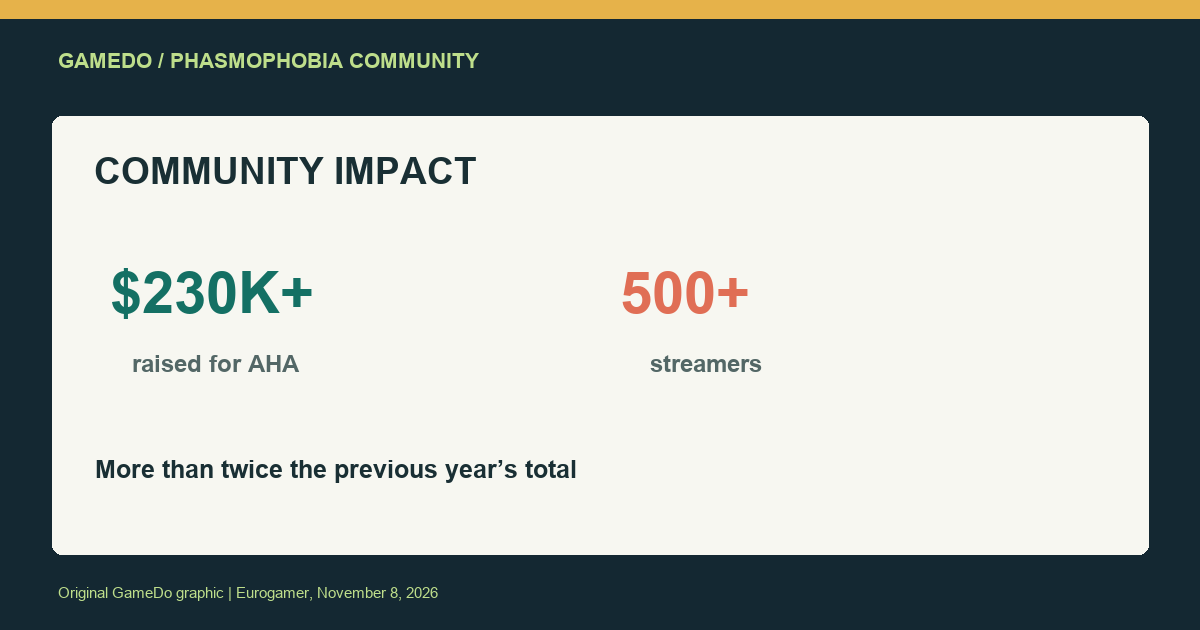
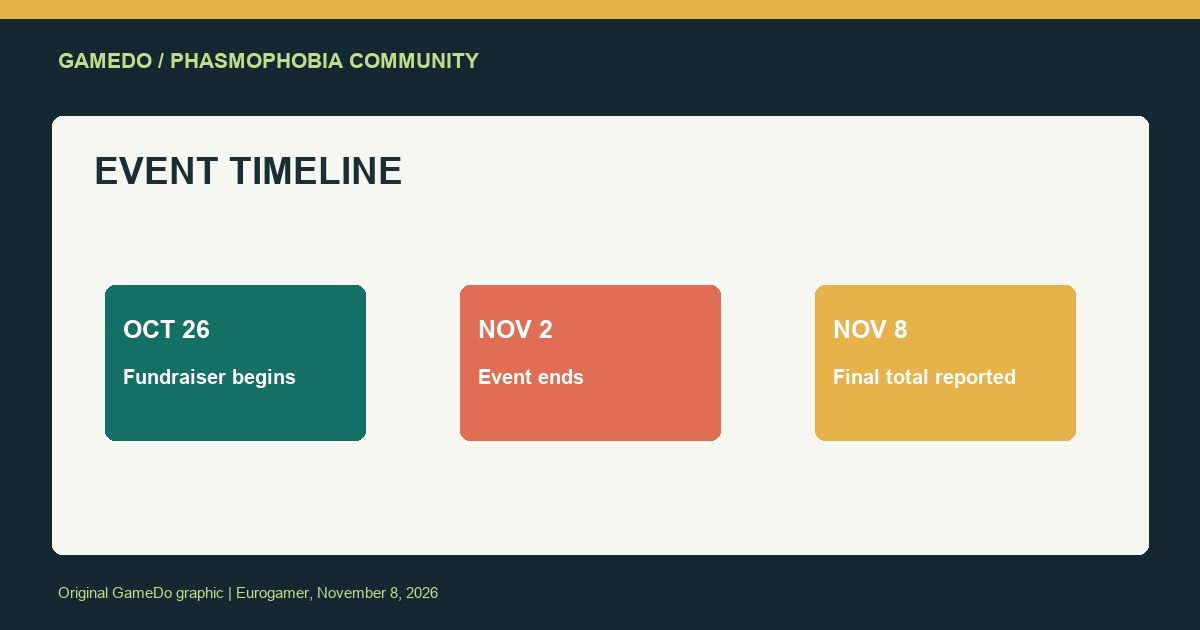
The Phasmophobia community raised more than $230,000 for the American Heart Association through the 2026 Ghost Hunts for Hearts fundraiser, according to a final total announced by developer Kinetic Games and reported by Eurogamer on November 8. More than 500 streamers took part. The fundraiser ran from October 26 through November 2, and the final total more than doubled the previous year’s result.
The campaign is a useful example of how a multiplayer horror game’s creator community can turn a seasonal event into a real-world charity drive. Here is what was reported, how the event worked, what the numbers do and do not tell us, and how players can verify future fundraising campaigns before donating.
The reported result
Eurogamer reported on November 8 that Ghost Hunts for Hearts raised more than $230,000 for the American Heart Association. Kinetic Games announced the final figure on November 6. More than 500 streamers signed up, making it the largest turnout yet for a creator fundraiser run through Heart Liive, the American Heart Association’s streaming initiative, according to the report.
The developer had set a $200,000 goal. The campaign exceeded that target, and the reported final total was more than twice the little-over-$100,000 raised the year before. These figures are attributed to Kinetic Games and Eurogamer’s coverage; they are not an independent audit by GameDo.
How Ghost Hunts for Hearts worked
The event ran from October 26 to November 2, 2026. Streamers played Phasmophobia and raised money for the American Heart Association through Heart Liive. The creator-led format gave viewers a way to support the cause while watching familiar streamers play a cooperative horror game.
Phasmophobia sends teams of up to four players into haunted locations to gather evidence about what is present. That cooperative structure lends itself to livestreams: players can coordinate, react to scares, and make decisions in front of an audience. During the fundraiser, participating streamers could offer viewers an event-exclusive Advocate ID Card and Badge as a Twitch Drop. Kinetic Games also announced an animated version after the community passed the $200,000 target.
Why the total matters to U.S. players
The American Heart Association is a U.S.-based health organization, and the fundraiser connected a gaming audience to its work. A community fundraiser can also make charitable giving more visible to people who might not encounter a traditional campaign. Streamers provide a social setting, while game rewards give viewers a limited in-game memento of their participation.
The amount raised is impressive, but a dollar total alone does not explain the full impact. The report does not break down how much came from individual donations, matching funds, platform incentives, or other sources. It also does not state the average donation size. Those details matter when comparing campaigns, so the headline total should be understood as the reported overall result rather than a complete financial breakdown.
How to verify a creator charity stream
Players who want to support future gaming fundraisers can take a few basic steps:
- Check the beneficiary. Confirm the nonprofit and campaign using the organization’s official site or a recognized fundraising partner.
- Use the stated donation link. Avoid links sent by unknown accounts in chat or direct messages.
- Read the donation terms. Check whether the platform adds fees, whether donations are refundable, and whether the campaign is eligible for tax documentation.
- Distinguish donations from merch or subscriptions. A paid subscription or purchase may support a creator without being a direct charitable donation.
- Protect personal information. Do not post payment details, verification codes, or sensitive information in a public stream chat.
For this event, Eurogamer says the initiative was run through Heart Liive and the beneficiary was the American Heart Association. Anyone researching future events should verify the current campaign page because donation links, organizers, and terms can change from year to year.
What players should know about the in-game rewards
The event included an Advocate ID Card and Badge that streamers could distribute to viewers through Twitch Drops. After the target was surpassed, an animated version was unlocked for all, according to the report. Players should check the official Phasmophobia account or event page for any claim windows and eligibility requirements. The report noted a November 15 deadline to log in and claim the animated item, so that window has now passed.
Cosmetic rewards can make participation feel memorable, but they should not be confused with the donation itself. A viewer may receive a drop for watching an eligible stream without donating, while other campaign mechanics may differ. Check the specific event rules rather than assuming a cosmetic item proves a donation was made.
Phasmophobia’s broader context
Phasmophobia launched in Early Access in September 2020 and remains an evolving game. It is available in Early Access on Steam, PlayStation 5, PlayStation VR2, and Xbox Series X|S, with a Nintendo Switch 2 version also announced. The game’s long-running community and creator ecosystem help explain why a streamer fundraiser could draw more than 500 participants.
The campaign’s result arrives amid continued development. Kinetic Games had moved the game’s 1.0 launch into 2027, according to the coverage, saying it was prioritizing quality after a difficult reception to a player-character update. That context does not diminish the fundraiser, but it reminds players that charitable events and game development milestones are separate stories.
Bottom line
Ghost Hunts for Hearts raised more than $230,000 for the American Heart Association, with more than 500 streamers participating between October 26 and November 2. Kinetic Games announced the final amount on November 6, and Eurogamer reported it on November 8. The campaign more than doubled the previous year’s total and exceeded its $200,000 target.
For players, the takeaway is both celebratory and practical: creator communities can bring attention and donations to established charities, but participants should still verify the beneficiary, use official links, and understand the terms. The event’s special Twitch Drops were a separate reward mechanic, and the reported claim window has passed.
Amounts and event details are attributed to Kinetic Games and Eurogamer’s November 8, 2026 report. This article does not independently audit donations.
Sources
- Eurogamer: Phasmophobia players raise over $230,000 for heart charity (November 8, 2026).
- American Heart Association: Heart Liive.
How a game community can make a campaign visible
Livestream fundraisers combine several forms of participation. A creator can explain why the cause matters, viewers can donate through the campaign platform, and other players can join by watching or sharing the event. In a cooperative game, the play itself gives the stream a shared activity that can keep a campaign visible for hours without turning every moment into a donation appeal.
That visibility does not guarantee that every viewer will give, and it should not create pressure to spend beyond one’s means. Watching an eligible stream, sharing verified information, or simply learning about the organization can also be forms of participation. A cosmetic Twitch Drop is a bonus, not a measure of generosity.
The event also shows why transparent goals can help a community understand progress. Kinetic Games set a $200,000 target, and the animated reward was unlocked after participants passed it. A clear goal gives viewers a shared milestone, while reporting the final total afterward closes the loop. For future campaigns, organizers can build trust by stating the dates, beneficiary, donation method, reward rules, and how the final amount will be reported.
Understanding the American Heart Association connection
Heart Liive is the American Heart Association’s creator and streaming initiative, according to the reporting. It offers a route for gaming and livestream communities to support the organization. Because fundraisers can involve a platform, creator, game publisher, and nonprofit, it is useful to understand who processes the donation and who receives it. The official campaign page should identify the beneficiary and explain any fees or terms.
If you are in the United States and want to support heart-health programs outside a special game event, use the American Heart Association’s official donation channels. Do not assume that an old stream link remains active or that a social post is still connected to the same campaign. Confirm the recipient and campaign dates before entering payment details.
Why Phasmophobia fits a creator event
Phasmophobia’s teams of up to four players create natural moments for collaboration and audience participation. Players gather evidence, communicate under pressure, and react to unpredictable scares. That makes the game easy for a streamer to explain to viewers, while the shared objective gives a group a reason to keep playing together.
The format can also bring different parts of the community into one event: experienced investigators, newer players, streamers, and viewers who may not own the game. The reported 500-plus streamer participation suggests a broad creator response, although the number does not tell us how many viewers donated or how donations were distributed across the event.
How to read charity totals responsibly
A campaign total is a useful headline, but it is only one piece of accountability. Look for a clear beneficiary, a campaign platform, a final statement from the organizer, and any notes about matching gifts or fees. If a report gives only a rounded figure, use the same careful phrasing instead of converting it into an exact audited amount.
Here, the available reporting says “more than $230,000.” That should remain “more than” rather than be presented as a precise final ledger. The coverage also says the amount was more than double the previous year’s little-over-$100,000 result; it does not provide a full year-by-year accounting. These qualifications keep the story accurate without minimizing the community’s achievement.
What streamers and organizers can carry forward
For creators planning a future charity stream, the event offers several practical lessons. Set a clear fundraising target, explain what counts toward it, link directly to the verified campaign page, and publish a closing update with the final result. If viewers can earn a digital reward, describe the eligibility window separately from the donation process so nobody assumes that a drop requires payment or that a donation automatically grants an item.
Creators should also plan for moderation. Charity streams attract attention from genuine supporters as well as impersonators who may post fake links. Pin the official campaign URL, remove suspicious payment requests, and remind viewers that moderators will never ask for passwords or verification codes. These steps protect both the charity and the community supporting it.
For game developers, optional in-game rewards can help create a shared milestone, but they should not obscure the beneficiary or the donation route. A clear separation between watching, receiving a drop, and giving money helps players make an informed choice. The reported Advocate Card and Badge connected viewers to the event, while the fundraising total remained tied to the charity campaign itself.
What players can do after the event
The 2026 event window is over, and the reported November 15 in-game reward claim deadline has passed. Players should not trust third-party pages claiming to reopen the drop or sell a code that was meant to be distributed through official Twitch Drops. For future Phasmophobia events, follow the developer’s official channels and the American Heart Association’s Heart Liive updates.
If you missed this fundraiser but want to help, you can support the American Heart Association directly through its official site or take part in a later verified Heart Liive campaign. You do not need to donate through an unofficial reseller or send money to a streamer’s personal account unless the campaign explicitly documents that method.
Bottom line for the Phasmophobia community
Ghost Hunts for Hearts brought together a large group of creators around a recognizable cooperative game and a U.S. health charity. The reported result—more than $230,000 from a campaign involving over 500 streamers—shows the scale the community reached, while the event dates and final report make clear that this was a completed campaign rather than an ongoing donation drive.
The best way to celebrate the result is to keep the information precise: attribute the total to the organizers’ report, recognize the American Heart Association as the beneficiary, and avoid presenting expired rewards or donation links as still active. Those habits help preserve trust when players join the next community fundraiser.