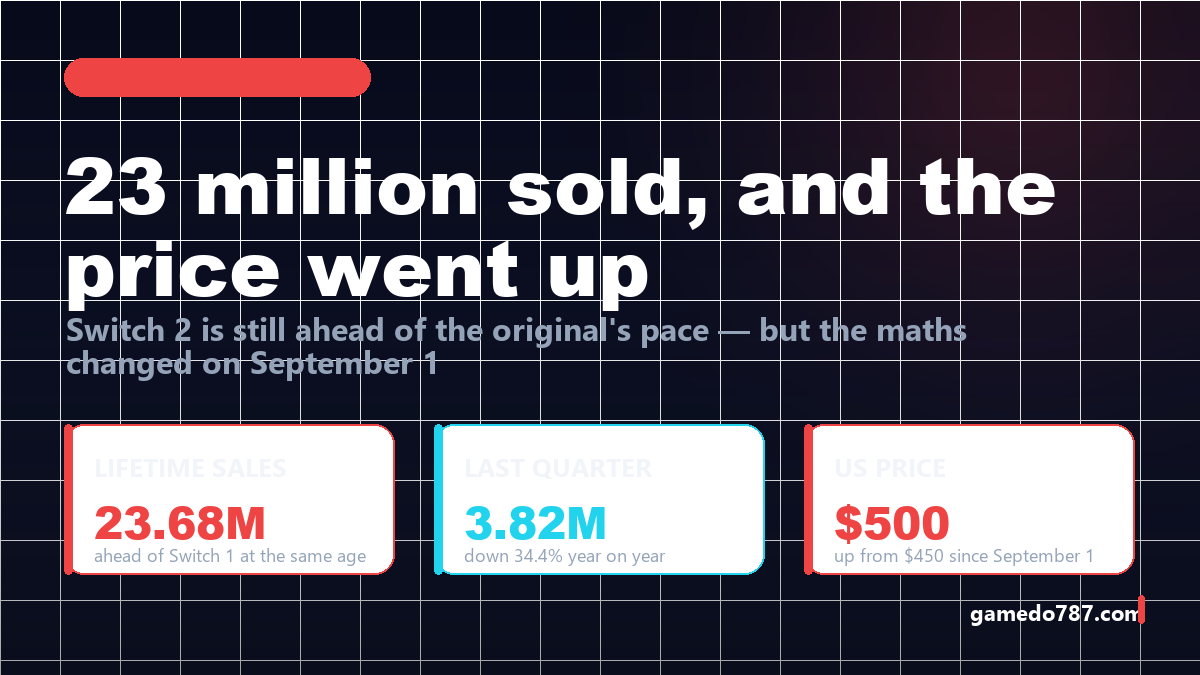
Nintendo’s Switch 2 has now sold 23.68 million units worldwide, but the console got more expensive in the middle of its own success story: the US price moved from $450 to $500 on September 1, 2026. The most recent quarterly disclosure showed 3.82 million units sold in the April-to-June window, a 34.4% drop year on year, while Nintendo kept its full-year target of 16.5 million unchanged. Whether that price still makes sense for you depends on which three exclusives you can actually name.
The numbers Nintendo actually published
These figures come from Nintendo’s April-to-June quarter disclosure, the most recent official update. The next earnings report is expected in early November, and it will be the first to show a full quarter at the higher US price.
| Metric | Figure | What it means |
|---|---|---|
| Lifetime Switch 2 sales | 23.68 million | Still ahead of the original Switch at the same age |
| Units, April–June quarter | 3.82 million | Down 34.4% against the same quarter last year |
| Full-year target (to March 2027) | 16.5 million | Unchanged despite the slowdown |
| Previous full year | 19.86 million | The bar Nintendo set for itself in year one |
| US price change | $450 → $500 | Effective September 1, 2026 |
The headline that got repeated everywhere — “Switch 2 sales fall 34%” — is technically true and analytically useless on its own. A console in its second year is being compared against a launch quarter that was supply-constrained in the opposite direction: everyone who wanted one at any price bought one immediately. The more informative comparison is cumulative, and there Switch 2 is still tracking ahead of the original Switch, which went on to become one of the best-selling consoles ever made.
Why the drop is not (only) about demand
Three things are happening at once, and only one of them is about people losing interest.
The launch cohort has been served
Year-one buyers are not a renewable resource. Nintendo sold 19.86 million units in the previous fiscal year to people who were waiting for exactly this console. Those customers will not buy a second one. The question was never whether the second year would be smaller — it was whether it would be big enough to hold a 16.5 million target, and Nintendo says it is.
Component costs went the wrong way
Nintendo has flagged roughly 100 billion yen in added cost from rising component prices — memory in particular — along with the effect of US import tariffs. That is the real driver behind the $50 increase: not opportunism, but a bill that arrived after the price was set. Memory pricing has been ugly across the entire electronics industry this year, and consoles are unusually exposed because they ship with a fixed bill of materials that cannot be re-engineered mid-generation.
Worth understanding why memory hurts a console more than a phone. A phone can absorb a memory price rise by cutting the camera module or shipping fewer units at a higher margin; nobody notices. A console has a published spec sheet, a seven-year service life, and a business model that assumes selling tens of millions of near-identical boxes at thin hardware margins. There is no room to quietly downgrade, because the whole value proposition is that every unit runs the same games the same way. When memory goes up, the price goes up, or the platform eats it until it cannot.
Nintendo chose the first option, and it chose it earlier than most analysts expected. That decision is also the strongest available signal about the rest of the generation: if a $50 increase was necessary to protect margins in year two, an unannounced price cut in year three is not coming.
Tariffs cut both ways, briefly
Nintendo’s revenue actually beat expectations in the same period, helped by strong software sales and roughly $300 million in US tariff refunds. That is a one-time accounting boost, not a structural improvement, and it would be a mistake to read the revenue beat as evidence that hardware is healthy at $500.
The actual reason the console is still selling: software
Hardware numbers get the headlines; software is what keeps the platform alive between price hikes. And on that front Nintendo had an unusually strong quarter.
Tomodachi Life: Living the Dream moved 7.96 million copies in its first three months — a number that would be a franchise high for most publishers and is barely remarked upon here because Nintendo does this routinely. Pokémon Pokopia added 1.27 million outside Japan, and Mario Kart World and Donkey Kong Bananza continued to shift units as the default bundled and evergreen picks.
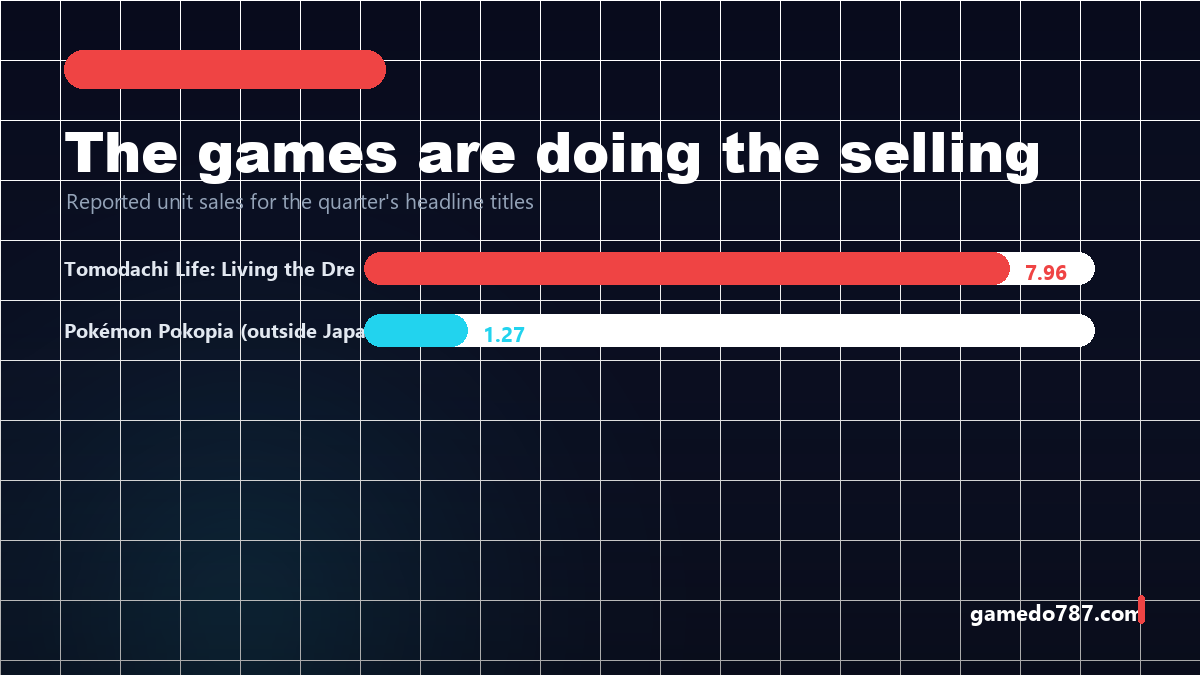
This is the part of the argument that gets lost. A console at $500 with a thin library is a bad purchase. A console at $500 where one life-sim sold eight million copies in a quarter and a Pokémon spin-off crossed a million outside its home market is a different proposition — and that is before the holiday slate lands.
So is it worth $500 now?
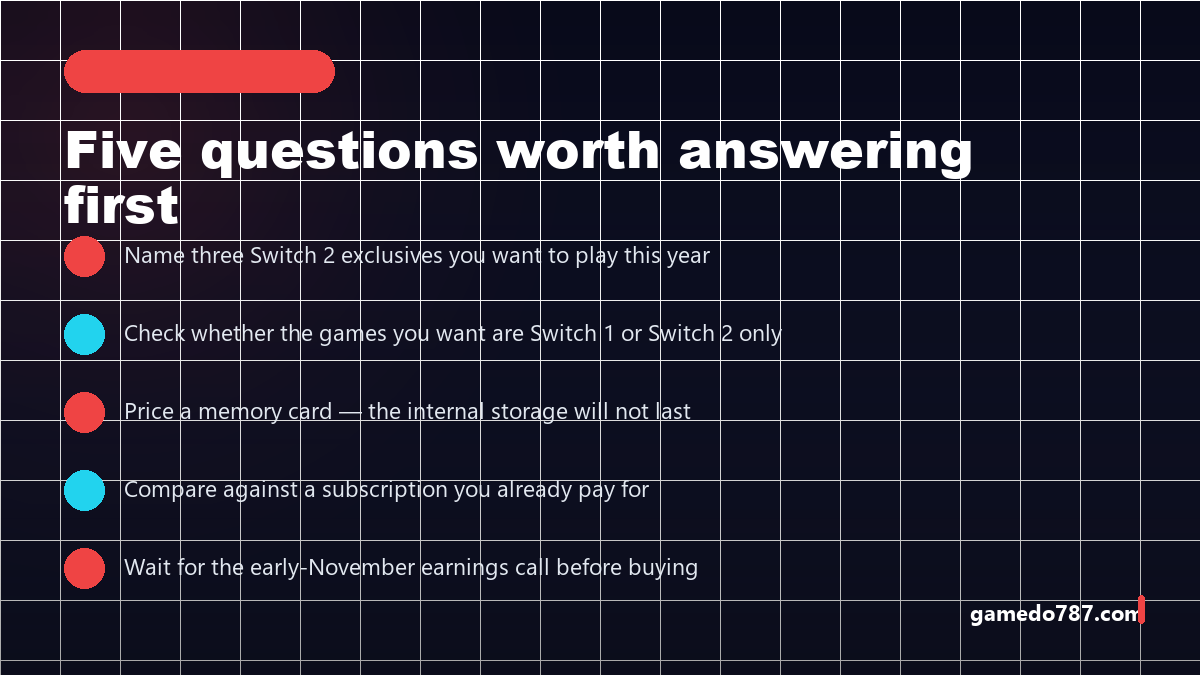
Answer this honestly and the decision makes itself: can you name three Switch 2 exclusives you personally want to play in the next six months? If yes, buy it — you are paying for a library, and the library is the strongest it has been. If you are listing one game and a vague sense that you should own a Nintendo console, wait. The price is not going to fall, but the bundle you get for it will improve.
The storage tax nobody budgets for
Switch 2 games are large. If you plan to play more than a handful of full-price titles at once, you will buy expandable storage within the first month, and that is a real addition to the $500. Include it in the comparison before you decide the console is “only” $500 — the honest entry price is a little higher.
The controller question
Nintendo’s Joy-Con drift problem is not ancient history. A French consumer ruling against the company over drift failures was reported earlier this year, and it matters to buyers because controller replacement is the most common ongoing cost of owning a Switch. If you play anything with sustained stick input, budget for a second controller or a repair programme, whichever applies in your region.
What else $500 buys in late 2026
This is where the price increase genuinely bites, because the alternatives at that number have improved dramatically in the last two years.
If your library lives on Steam and your problem is hardware, $500 is roughly two years of a high-end cloud gaming subscription — no hardware, your existing games, and a much better resolution ceiling than people expect. We compared the services in detail in our GeForce Now vs Xbox Cloud vs Luna breakdown, and the honest conclusion there was that a rented rig is the correct answer for anyone with a big PC library and a weak machine.
If your interest is broad rather than Nintendo-specific, $500 also buys more than two years of a subscription service with hundreds of games attached, which is a different value proposition entirely: fewer games you own, far more games you can try. Our breakdown of what Game Pass and PS Plus tiers really cost works through that arithmetic if you are weighing it.
None of that makes the Switch 2 a bad buy. It makes it a specific buy. Nintendo’s exclusives are not available anywhere else, at any subscription price, and that is the whole case — a case that got $50 more expensive without getting any wider.
There is one more competitor that is not a competitor yet: Grand Theft Auto VI arrives on November 19, and for a very large number of people that purchase will consume the entire entertainment budget of the quarter. If you are deciding between a Nintendo console and a single enormous open-world game, the timing is not neutral. Our GTA 6 release date, price and preload guide has the current details if that is the comparison you are actually making.
Who should skip the Switch 2
Three profiles, stated plainly, because most hardware advice refuses to say this out loud.
If you already own the original Switch and play mainly first-party games, the question is not whether the new console is better — it is whether enough of its library is Switch-2-only. Many of the biggest titles still run on the older hardware, and “runs worse on the machine I already own” is not a $500 problem for everybody.
If you mostly play online shooters or western open-world games, the Switch 2 is the wrong primary console and likely a bad secondary one. Its value is its exclusives and portability, and neither of those helps you play a competitive shooter at 120 frames per second with your friends on another platform.
If $500 is your ceiling rather than your budget, wait for the actual box contents to change. Nintendo pairs consoles with software when targets are at risk — that is the mechanism, and early November is when we learn whether the pressure exists. Buying three weeks before that report is buying the least favourable configuration of the year.
The part that has nothing to do with games
Nintendo is no longer only a games company, and the Switch 2’s price strategy reflects it. The Super Mario Galaxy Movie has grossed more than one billion dollars worldwide since its April 2026 release, making it the second-highest-grossing video game adaptation ever, behind the previous Super Mario film. That business gives Nintendo a revenue cushion that most hardware makers do not have, and it explains why the company can absorb a tariff hit and still hold a 16.5 million unit target instead of chasing volume with price cuts.
It also means the console’s role has shifted. For a large chunk of the audience, Switch 2 is the device that keeps the film and merchandise ecosystem connected to an interactive product. That is a durable reason for Nintendo to keep the install base growing, and a weak reason for you to pay $500 if you are not actually going to play the games.
What to watch in the next six weeks
The early-November earnings report is the first real test of the $500 price. Two numbers matter: whether the 16.5 million target survives, and whether software attach rates hold up when the hardware costs more. If Nintendo cuts the target, expect a bundle within one quarter. If it holds, expect the price to stay exactly where it is until memory costs move.
Either way, the console is not becoming cheaper. The only variable is what comes in the box with it, and that — not the sticker price — is what a patient buyer should be watching.
FAQ
How many Nintendo Switch 2 consoles have been sold?
23.68 million units cumulatively as of Nintendo’s most recent quarterly disclosure. That still puts it ahead of the original Switch’s pace at the same point in its life.
Why did the Switch 2 get more expensive?
Nintendo cited rising component costs — memory in particular — plus the impact of US import tariffs, amounting to roughly 100 billion yen in added cost. The US price went from $450 to $500 on September 1, 2026.
Did Switch 2 sales actually fall 34%?
Yes, for the April-to-June quarter: 3.82 million units, down 34.4% year on year. But that compares against a launch quarter, when demand was artificially constrained by supply, so the year-on-year drop overstates any loss of interest.
Is the Switch 2 still worth buying at $500?
If you can name three Switch 2 exclusives you want to play in the next six months, yes. If you cannot, wait — the price will not drop, but bundles and the library will improve, and the early-November earnings report will tell you how much pressure Nintendo is under.
Will the Switch 2 price ever come back down?
Not likely on its own, because the two forces that pushed it up — memory pricing and import tariffs — are outside Nintendo’s control and applied to a fixed bill of materials. Any effective discount will arrive as a bundle with a game or a memory card rather than as a lower sticker price.
Does the price increase apply everywhere?
The $450-to-$500 change reported for September 1, 2026 was a US adjustment driven by tariffs and component costs. Regional pricing moves separately, so check your local retailer rather than converting another market’s number.
Bottom line
The Switch 2 is selling faster than its predecessor did and costs $50 more than it did in August, and both facts are true simultaneously. Nintendo is holding its target because the software is genuinely strong — Tomodachi Life alone sold nearly eight million copies in three months — while memory prices and tariffs make a price cut essentially impossible. Buy it for the exclusives you can name today, not for the ones you hope will arrive, and treat the storage and controller costs as part of the $500.