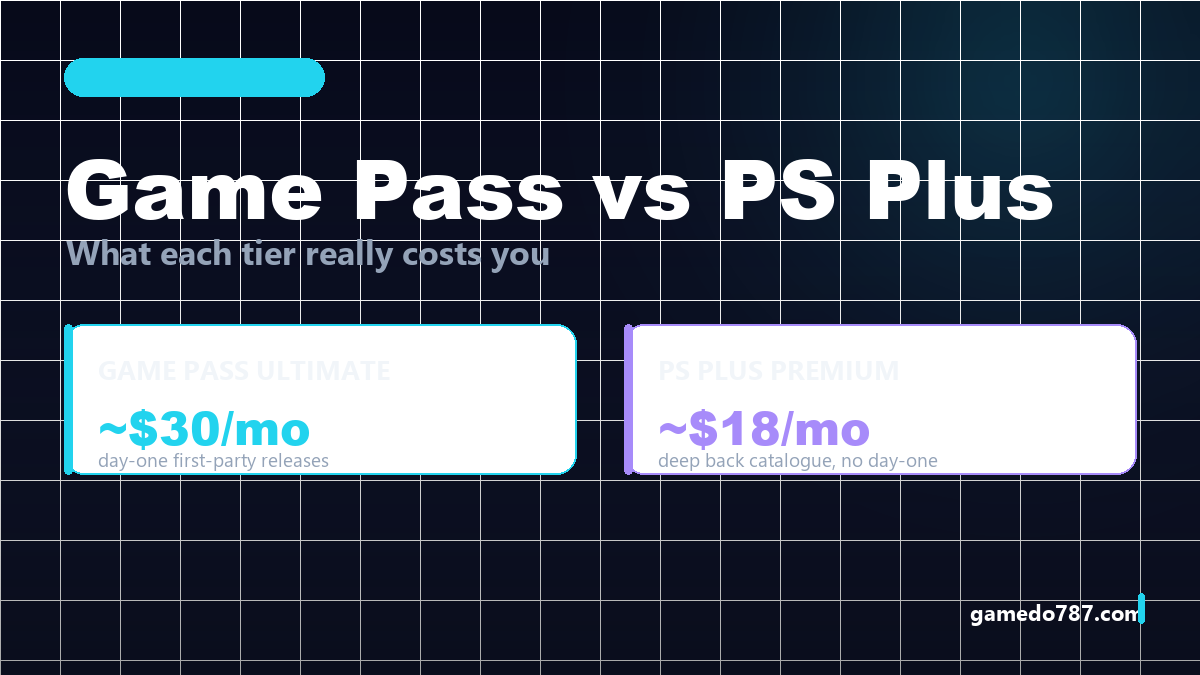
Every year the same question lands in the same inbox: is Xbox Game Pass or PlayStation Plus actually worth the money in 2026? The honest answer is that the two services stopped being comparable products a while ago. One is a rental library that wants to be Netflix. The other is an online-play toll booth with a catalogue bolted on top. Once you price them out month by month, the gap gets obvious fast.
This breakdown does the math you would otherwise do in a spreadsheet on a Sunday night: what each tier costs, what it unlocks, where the day-one releases actually land, and which one wins for the way you personally play.
The short version: if you play on PC or you care about new releases on launch day, Game Pass Ultimate is the stronger buy. If your hardware is a PlayStation and you mostly play online with friends plus a back catalogue, PS Plus Extra is the better value. If you own both consoles and subscribe to both, you are almost certainly paying twice for the same third-party games.
The tiers in 2026, side by side
Both services now run three consumer tiers. Microsoft consolidated its naming a while back, so ignore any guide older than 2025 — the entry-level tier is no longer called “Core” in most regions.
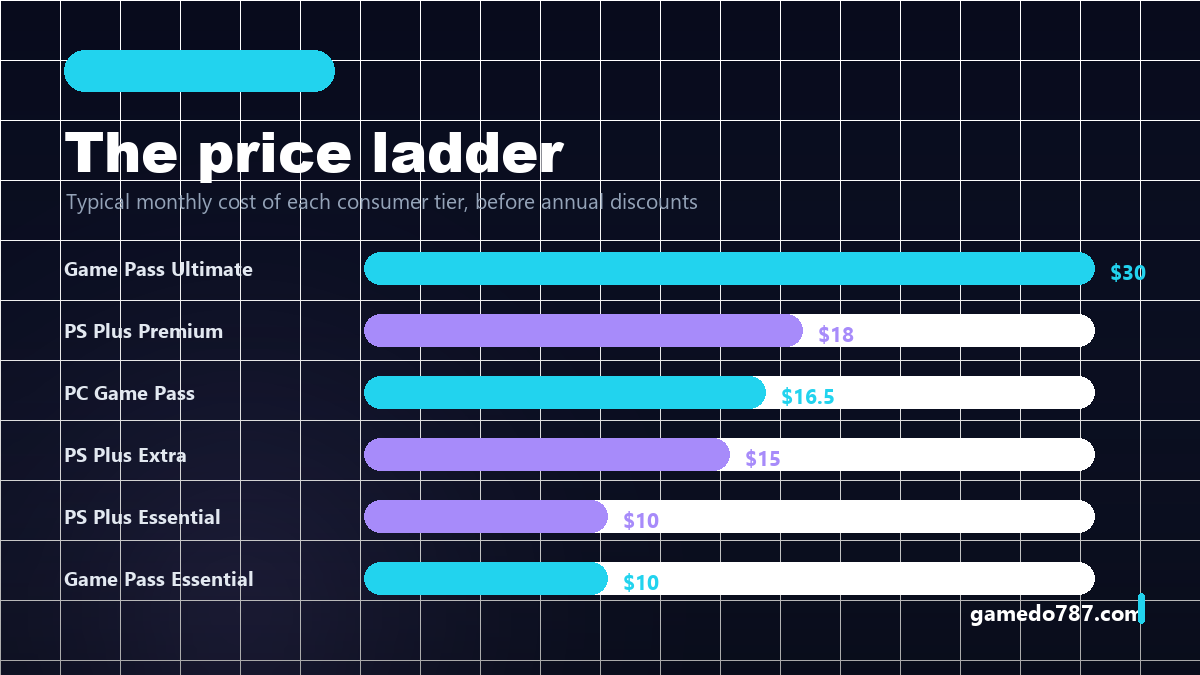
| Service & tier | Typical monthly price (US) | What it actually gets you |
|---|---|---|
| Game Pass Essential | ~$10 | Online multiplayer, a rotating set of around 25 games, no day-one first-party titles |
| Game Pass Premium | ~$15 | Bigger catalogue, still no launch-day first-party access, no cloud library |
| Game Pass Ultimate | ~$30 | Console + PC + cloud in one subscription, day-one first-party releases, EA Play included |
| PC Game Pass | ~$16.50 | PC-only equivalent of Ultimate, same day-one releases |
| PS Plus Essential | ~$10 | Online play, three monthly games you keep while subscribed, cloud saves |
| PS Plus Extra | ~$15 | Everything in Essential plus a catalogue of several hundred PS4 and PS5 games |
| PS Plus Premium | ~$18 | Everything in Extra plus classics, game trials and cloud streaming |
Prices move, and they move in one direction. Treat the numbers above as the shape of the pricing ladder rather than a quote — check your regional store page before you commit to a year, because both companies have been quietly repricing annual plans to make monthly billing look cheaper by comparison.
The real differentiator: day-one releases
Everything else in this article is detail. This is the decision.
Game Pass Ultimate and PC Game Pass include Microsoft’s first-party games on the day they launch, at no extra charge. That is not a marketing line — it changes how you budget for games. A year with four big first-party releases at full price is roughly the cost of a year of Ultimate, and you would also get the rest of the catalogue and online play in the same payment.
PlayStation Plus does not do this. Sony’s first-party titles arrive in the Extra catalogue months or years after launch, and the biggest ones sometimes never arrive at all. What you get instead is a very deep back catalogue: the single-player epics that defined the PS4 generation, plus a steady stream of third-party games that have already finished their retail life.
That is a genuine trade, not a scam. If you buy two or three new PlayStation games a year at full price, Extra is a back-catalogue service you are layering underneath them. If you buy a lot of new games at full price and you own an Xbox or a gaming PC, Ultimate is subsidising your year.
Library size, honestly measured
Both companies love quoting four-digit game counts, and both counts include games you would never install. A more useful measure is how many games in the catalogue you would actually finish.
- PS Plus Extra has the stronger single-player shelf. If you missed the big narrative exclusives of the last decade, you can spend a year working through them and never touch a full-price purchase.
- Game Pass has the stronger rotating shelf — more indie day-one additions, more co-op and “just try it” games, and a habit of dropping a title you were curious about but would never have paid for. Our piece on why indie games are outselling AAA in 2026 explains why that rotation matters more now than it used to.
- PS Plus Premium’s classics catalogue is the weakest value of the three tiers. The streaming is convenient, the emulation is fine, but the list of genuinely great older games is thinner than the price difference suggests.
Where Game Pass wins outright: PC
If you game on a PC, the comparison is not close. PS Plus has no native PC catalogue — Premium’s cloud streaming is a console library rendered on a server, not PC games you install. PC Game Pass gives you release-day access to Microsoft’s own titles, EA Play, and a catalogue that installs and runs natively.
For a PC player the practical question is not “which service”, it is “which tier”. If you never touch cloud gaming and you do not own an Xbox, PC Game Pass gives you the same day-one releases as Ultimate for roughly half the money. Ultimate only makes sense if you also want the console library or you genuinely use cloud streaming on a handheld or a TV stick.
Cloud streaming and handhelds
This is the one axis where the two services are not even playing the same sport. Game Pass cloud streaming is a first-class feature: it works on phones, tablets, browsers, some smart TVs and most modern handhelds, and because the games are already in your subscription there is no separate purchase to stream.
PS Plus Premium’s streaming is a way to play PlayStation games without the console in the room. It works, it has improved, and it is still a premium-tier perk rather than the reason to subscribe. If you own a handheld PC, the streaming comparison alone is usually enough to settle the argument.
Which one should you actually buy?
| Your situation | Buy this | Why |
|---|---|---|
| PC only, plays new Microsoft titles | PC Game Pass | Day-one releases at the lowest price, no console features you cannot use |
| Xbox + PC, plays a lot of new releases | Game Pass Ultimate | One payment covers both devices and includes cloud |
| PS5 only, plays online with friends | PS Plus Essential | Online play is all you need; add Extra only if the catalogue appeals |
| PS5 only, single-player backlog | PS Plus Extra | The strongest back catalogue in the industry for the price of one game every two months |
| Both consoles, tight budget | One service, rotating | Subscribe for three months, finish what you want, cancel, switch |
| Casual, plays two games a year | Neither | Buy the games outright; subscriptions lose to à la carte below roughly 3 games a year |
The trap: subscribing to both
The most common mistake is running Ultimate and PS Plus Extra at the same time. Do the overlap check before you renew either one: open both catalogues side by side and count the games you actually want to play that appear in both. In practice the third-party overlap is large — big publishers take the cheque from whoever offers it, and both services end up carrying the same mid-generation catalogue.
If you keep both, you are paying roughly $45 a month for the privilege of ignoring most of what you bought. Rotate instead: three months of one, then three months of the other. Nothing in either catalogue is urgent enough to justify a permanent double subscription.
Cheaper ways to hold a subscription
- Annual billing. Both services discount the yearly plan heavily. If you know you will stay for twelve months, monthly billing is a donation.
- Prepaid codes during sales. Retailers discount 3-month and 12-month codes around Black Friday and the major seasonal sales. Codes stack — buying three discounted 12-month codes is cheaper than renewing monthly for three years.
- Conversion windows. Microsoft has repeatedly allowed cheaper tiers to convert into Ultimate at a favourable ratio when upgrading. Watch for those windows; they are the single cheapest way to hold Ultimate.
- Game-sharing. Both ecosystems let a second console on the same account play your library. One subscription, two people playing, if you trust the person.
Frequently asked questions
Is Game Pass Ultimate still worth $30 a month?
Yes, if you play at least two full-price games a year across console and PC, or if you use cloud streaming regularly. It stops being worth it the moment you are paying for it out of habit and only playing one free-to-play game.
Does PS Plus still require a subscription to play online?
Yes for paid games. Free-to-play titles do not need PS Plus to play online, which is why so many PlayStation owners with a single free-to-play habit pay nothing at all.
Can I play Game Pass games on a Steam Deck?
Through the browser or a cloud-gaming front end, yes — cloud streaming works well on a Deck. Native installs are a Windows affair, so a Steam Deck is a streaming device for Game Pass rather than a local one.
Which service has better day-one releases in 2026?
Game Pass, without much argument. Microsoft puts its own releases in the subscription at launch; Sony sells its own releases and adds them to the catalogue later, if at all.
What happens to my games if I cancel?
You lose access to everything you did not buy outright. Games claimed through PS Plus Essential stay in your account and come back if you resubscribe; catalogue games simply disappear. Saves are preserved in the cloud for a period after cancellation on both services.
Verdict
On pure value per dollar, Game Pass Ultimate is the stronger product in 2026 — it is the only subscription that hands you brand-new releases on launch day, and it is the only one that treats PC as a first-class platform. PS Plus Extra is the better product for a specific kind of player: someone with a PS5, a taste for long single-player games, and no interest in paying full price for a decade-old masterpiece they never got around to.
Pick one. Rotate when you finish what you came for. And if you are counting down to a certain November release, our GTA 6 launch guide covers the preload and storage math before you commit your drive space to it.